luso-mt: Technical Report
How we built luso-mt: transfer from MADLAD-400 and distillation into 20M and 88M parameter students, a three-seed ablation with a matched-exposure control, luso-mt-3b, and an evaluation with significance tests, language identification and on-device measurements.

Byamasu Patrick Paul
17 min read

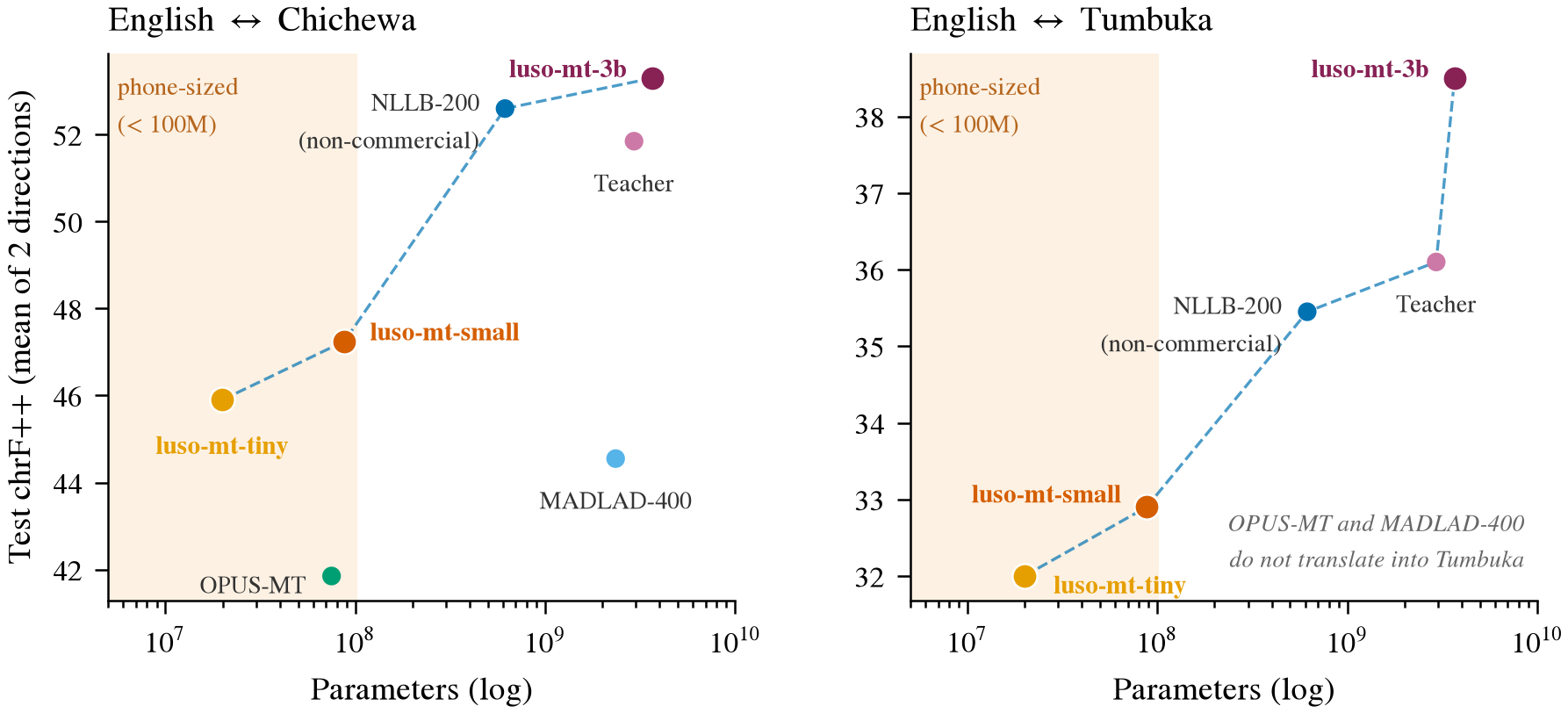
Abstract. Machine translation for Chichewa and Tumbuka is constrained by scarce parallel data, few models licensed for commercial use and the computational cost of existing multilingual systems. We present luso-mt, a family of compact English–Chichewa and English–Tumbuka translation models built for on-device use. We adapt MADLAD-400 3B to Malawian data and use sequence-level knowledge distillation to train two encoder-decoder students from scratch: luso-mt-tiny (19.9M parameters, 40.5 MB in int8) and luso-mt-small (87.7M, 153.5 MB). On held-out NTREX-128 and SMOL test sets, luso-mt-small reaches 47.6, 46.9, 35.8 and 30.0 chrF++ (en→ny, ny→en, en→tum, tum→en), significantly above the comparably sized OPUS-MT models in every direction they support, and the two students are the only compact models we evaluated that translate into Tumbuka. luso-mt-tiny keeps 84–93% of its teacher's chrF++ at 1/148 of its size, and int8 quantisation changes chrF++ by at most 0.3. A larger model, luso-mt-3b, exceeds NLLB-200 distilled 600M in three of four directions. Across 18 student runs with three seeds, a control matched in training rows per epoch shows that most of the gain from distillation comes from additional training exposure; the teacher's translations add a further 1.5 chrF++ to luso-mt-small and a non-significant 0.7 to luso-mt-tiny. We release all three models under Apache-2.0 with all benchmark outputs; the training corpus is not released.
 luso-mt-tiny ·
luso-mt-small ·
luso-mt-3b ·
luso-mt-benchmark ·
Code ·
Full report (PDF)
This page summarises the technical report. The full report (PDF, 21 pages) adds confidence intervals for every score, the tokenisation analysis, training curves, the error analysis, the training length of every run and the full compute log.
1. Introduction
Chichewa (ISO 639-3 nya) is the national language of Malawi and is spoken as a first or second language by most Malawians; closely related varieties are spoken as Nyanja in Zambia, Mozambique and Zimbabwe. Tumbuka (tum) is the main language of Malawi's Northern Region and is also spoken in eastern Zambia. Most public, health and agricultural information, and most of the web, is written in English.
Among the open translation models we evaluated (Section 4), those licensed for commercial use reach 41–43 chrF++ for Chichewa and 22–24 for Tumbuka into English, and none translates into Tumbuka. NLLB-200 is stronger but is licensed for non-commercial use only, and cloud services require a network connection and charge per request.
We set three design constraints: the smallest model should fit in 50 MB and the default model in 200 MB after quantisation; one model should serve all four directions; and every component should be releasable under a permissive licence. Within these constraints we ask:
- RQ1. How do compact multilingual models compare with existing models of similar size for English–Chichewa and English–Tumbuka translation?
- RQ2. What trade-offs exist between translation quality, model size and inference efficiency when compressing a large multilingual translation model for these languages?
- RQ3. How do sequence-level knowledge distillation, training exposure and student capacity affect translation quality in this setting?
The contributions are:
- luso-mt-tiny (19.9M parameters) and luso-mt-small (87.7M), released under Apache-2.0, which translate in all four directions with one network each, including into Tumbuka.
- luso-mt-3b, the teacher continued on a larger corpus and released under Apache-2.0, which has higher chrF++ than NLLB-200 distilled 600M in three of four directions.
- A three-seed ablation of distillation and student size with a control matched in training rows per epoch, which attributes most of the apparent distillation gain to additional training exposure, and a documented failed training run.
- An evaluation with confidence intervals, paired significance tests, metric signatures, tokeniser fertility, language identification, training-to-development gaps and error analysis, with every system's outputs released.
2. Related work
Multilingual translation. A single encoder-decoder with a shared vocabulary can serve many directions when a token at the start of the input names the target language (Johnson et al., 2017). This approach produced NLLB-200 (NLLB Team, 2022) and the translation models of MADLAD-400 (Kudugunta et al., 2023). Both cover Chichewa and NLLB-200 also covers Tumbuka, but NLLB-200 is released for non-commercial use only, while MADLAD-400 is released under Apache-2.0 without a Tumbuka target. OPUS-MT (Tiedemann and Thottingal, 2020) offers small single-pair models, including English–Chichewa and Tumbuka–English.
Compact translation. Sequence-level knowledge distillation trains a small student on a teacher's beam-search outputs (Kim and Rush, 2016); the Bergamot project used it to build CPU students for on-device translation (Bogoychev et al., 2020). A deep encoder with a shallow decoder decodes substantially faster than a balanced model with little loss in quality (Kasai et al., 2021).
Synthetic data and evaluation. Back-translation (Sennrich et al., 2016) with tagged synthetic sources (Caswell et al., 2019) produces most of our English text. SMOL (Caswell et al., 2025) provides professionally translated sentences and documents for both languages. We report chrF++ as the primary metric, which agrees with human system rankings more often than BLEU (Kocmi et al., 2021), and test differences with paired bootstrap resampling (Koehn, 2004).
3. Data and methodology
3.1 Data
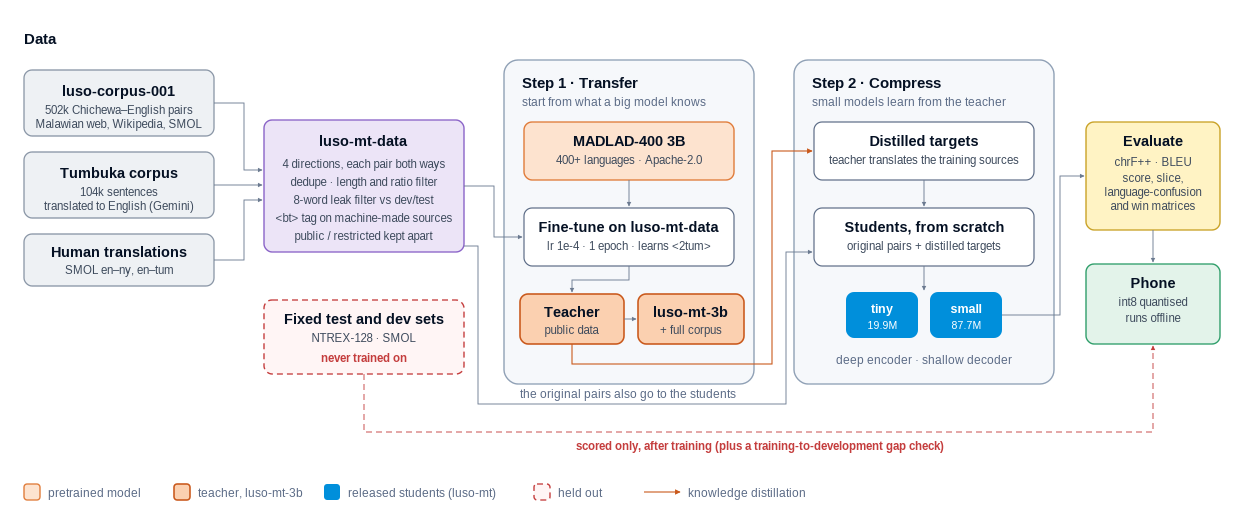
Most sentence pairs start from text written in Chichewa or Tumbuka, with the English side produced by machine translation, so the Chichewa and Tumbuka side is natural text; the synthetic English is marked with a <bt> tag when it is used as a source. The corpus has two partitions. The public-source partition is drawn from openly distributed sources and is used for luso-mt-tiny, luso-mt-small and their teacher. A restricted partition holds text whose terms do not permit redistribution; it is used only to train luso-mt-3b. The training corpus itself is not released.
| Source | Partition | English side | Pairs |
|---|---|---|---|
| Chichewa web text (FineWeb-2, HPLT, Wikipedia) | public-source | Gemini 3.8 Flash | 85,063 |
| Chichewa web text, long passages | public-source | Gemma 3 27B | 1,692 |
| SMOL sentences and documents (en-ny) | public-source | professional | 3,686 |
| Tumbuka Wikipedia and web text | public-source | Gemini 3.8 Flash | 50,938 |
| SMOL sentences and documents (en-tum) | public-source | professional | 1,597 |
| Public-source total | 142,976 | ||
| Additional Chichewa text | restricted | Gemini 3.8 Flash | 403,327 |
| Additional Tumbuka text | restricted | Gemini 3.8 Flash | 51,057 |
| All data | 597,360 |
Pairs after cleaning; each pair is used in both directions. The English side of the web text was generated with Gemini 3.8 Flash at temperature 0.1; before use it scored 37.0 (ny→en) and 43.9 (tum→en) chrF++, the two directions used for generation, on a 100-sentence SMOL sample per language pair that is separate from our test set. All machine-translated pairs were then checked by human reviewers. The 1,692 long passages translated with Gemma 3 27B were taken from an existing release.
Cleaning. Every sentence was identified with GlotLID (Kargaran et al., 2023) and, for Chichewa, with MillID; text below a confidence of 0.7 and 0.5 respectively was removed. Zambian and Mozambican varieties were removed with lexical and orthographic markers, Wikipedia bot stubs were capped at three per template, and pairs were deduplicated and kept only with 2–150 words per side and a length ratio between 1:3 and 3:1.
Held-out sets. Test and development sets were fixed before training. For Chichewa we use NTREX-128 (sentences 0–499 test, 500–999 dev), which is excluded from training entirely. For Tumbuka we use SMOL smolsent en-tum: after a seeded shuffle, 500 sentences form the test set and 300 the development set. Any training pair sharing an exact match or an 8-word window with a held-out sentence was removed (1,544 pairs). A check after training found no exact match and no shared 8-word window between any of the 1,194,720 training rows and the held-out sets. This does not rule out paraphrased overlap or contamination inherited from the pretrained teacher.
3.2 Model
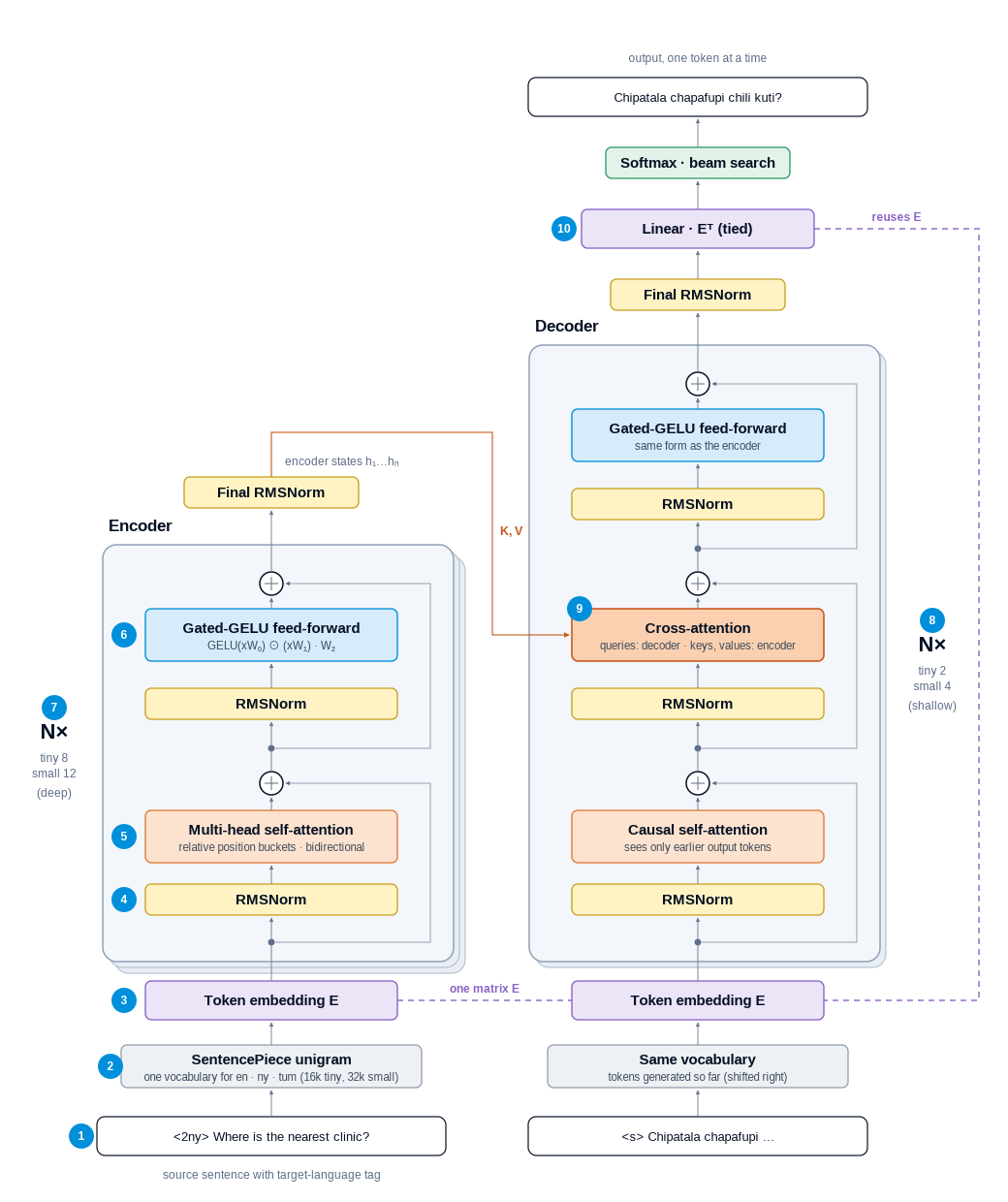
The students are encoder-decoder Transformers in the T5 v1.1 form: pre-norm RMSNorm, gated-GELU feed-forward layers and relative position biases. Input and output embeddings are tied, which saves 5.1M (tiny) and 16.4M (small) parameters. A target tag (<2en>, <2ny>, <2tum>) selects the output language, so one file serves all four directions, and most depth is placed in the encoder. For a 20-token output, luso-mt-small executes 12 + 4 × 20 = 92 layer passes against 252 for a balanced 12 + 12 model; layer passes are not equivalent to measured latency. Each student uses one unigram SentencePiece vocabulary shared by the three languages, trained for each run on that run's training data. These architectural choices are adopted from prior work and were not ablated.
| Model | dmodel | Heads | dff | Encoder layers | Decoder layers | Vocabulary | Parameters |
|---|---|---|---|---|---|---|---|
| luso-mt-tiny | 320 | 5 | 1,024 | 8 | 2 | 16,000 | 19.9M |
| luso-mt-small | 512 | 8 | 2,048 | 12 | 4 | 32,000 | 87.7M |
3.3 Teacher and luso-mt-3b
MADLAD-400 3B is released under Apache-2.0 but writes Chichewa poorly and has no Tumbuka tag. We add a <2tum> token and fine-tune the full model for one epoch on all four directions of the public-source partition (Adafactor, learning rate 1e-4, cosine schedule, batch 32 × 2, label smoothing 0.1, 7,917 steps on one H200), repeating Tumbuka pairs three times and human-translated pairs twice. luso-mt-3b continues this teacher for one epoch on the full corpus (11,000 steps).
3.4 Distillation into students
The teacher translates every public-source training source once with beam size 4; of 285,952 translations, 815 whose length ratio to the reference falls outside 0.5–2 are discarded. Each student is trained from random initialisation on the original pairs plus the teacher's translations.
| Setting | Value |
|---|---|
| Optimiser | AdamW, learning rate 5e-4, inverse square root schedule, 4,000 warm-up steps, weight decay 0.01, gradient clipping 1.0 |
| Batch and precision | 256 sentence pairs, bf16; 192 tokens per side |
| Regularisation | dropout 0.1; label smoothing 0.1; subword sampling (alpha 0.5, 64 best segmentations) |
| Data balance | Tumbuka pairs repeated 3 times; every pair used in both directions |
| Stopping | up to 30 epochs; development chrF++ every 2,000 steps (greedy); patience 5 evaluations |
| Reference runs (1 × H200) | luso-mt-tiny: 29.4 epochs, 2.8 h; luso-mt-small: 27.4 epochs, 6.1 h; both ended by early stopping |
4. Experimental setup
Baselines. We evaluated the open checkpoints we found that list Chichewa or Tumbuka, all with the same pipeline; Hy-MT, PLaMo translate, TranslateGemma and SMaLL-100 cover neither language. Recent Gemma-based translation checkpoints reported to cover Chichewa and Tumbuka were not evaluated.
Evaluation protocol. All systems translate the test sets with beam size 4. The primary metric is chrF++ (Popović, 2017), BLEU (Papineni et al., 2002) is secondary, and both are computed with sacreBLEU 2.6.0. Differences are tested with paired bootstrap resampling over test sentences (1,000 resamples), which gives 95% confidence intervals and p-values. Every system's output on every test sentence is public in the luso-mt benchmark.
Training runs and seeds. Each student is trained in three conditions: without distillation (20-epoch limit), with distillation (30-epoch limit), and a matched-exposure control that repeats the original pairs twice under the 30-epoch limit. The control sees as many rows per epoch as a distilled run (992,184 against 990,729) but no teacher translations. Early stopping applies to all conditions. Every condition is run with seeds 13, 14 and 15 (18 runs); seed 13 gives the released models. Conditions are compared with Welch's t-test over the three seed means.
5. Results
5.1 Main results
| Model | Params | en→ny | ny→en | en→tum | tum→en | Licence |
|---|---|---|---|---|---|---|
| Phone-sized (under 100M parameters) | ||||||
| luso-mt-small | 88M | 47.6 / 20.1 | 46.9 / 23.6 | 35.8 / 8.2 | 30.0 / 8.8 | Apache-2.0 |
| luso-mt-tiny | 20M | 46.3 / 19.1 | 45.5 / 22.0 | 34.9 / 8.1 | 29.1 / 7.9 | Apache-2.0 |
| OPUS-MT (per pair) | 75M | 41.0 / 12.0 | 42.7 / 18.6 | not supported | 24.1 / 5.4 | CC-BY-4.0 |
| Large | ||||||
| luso-mt-3b | 2.9B | 51.7 / 23.1 | 54.9 / 32.9 | 40.7 / 12.6 | 36.3 / 14.2 | Apache-2.0 |
| Teacher (public data) | 2.9B | 49.9 / 21.9 | 53.8 / 31.4 | 37.5 / 9.7 | 34.7 / 12.7 | not released |
| NLLB-200 distilled | 615M | 50.0 / 20.1 | 55.2 / 34.2 | 38.2 / 13.0 | 32.7 / 12.0 | CC-BY-NC-4.0 |
| MADLAD-400 3B | 2.9B | 37.8 / 11.5 | 51.3 / 30.7 | not supported | 26.8 / 5.9 | Apache-2.0 |
Cells show chrF++ / BLEU on 500 sentences per direction; bold marks the best chrF++ in each group. Every difference between luso-mt-small and any other system is significant (paired bootstrap, p ≤ 0.007).
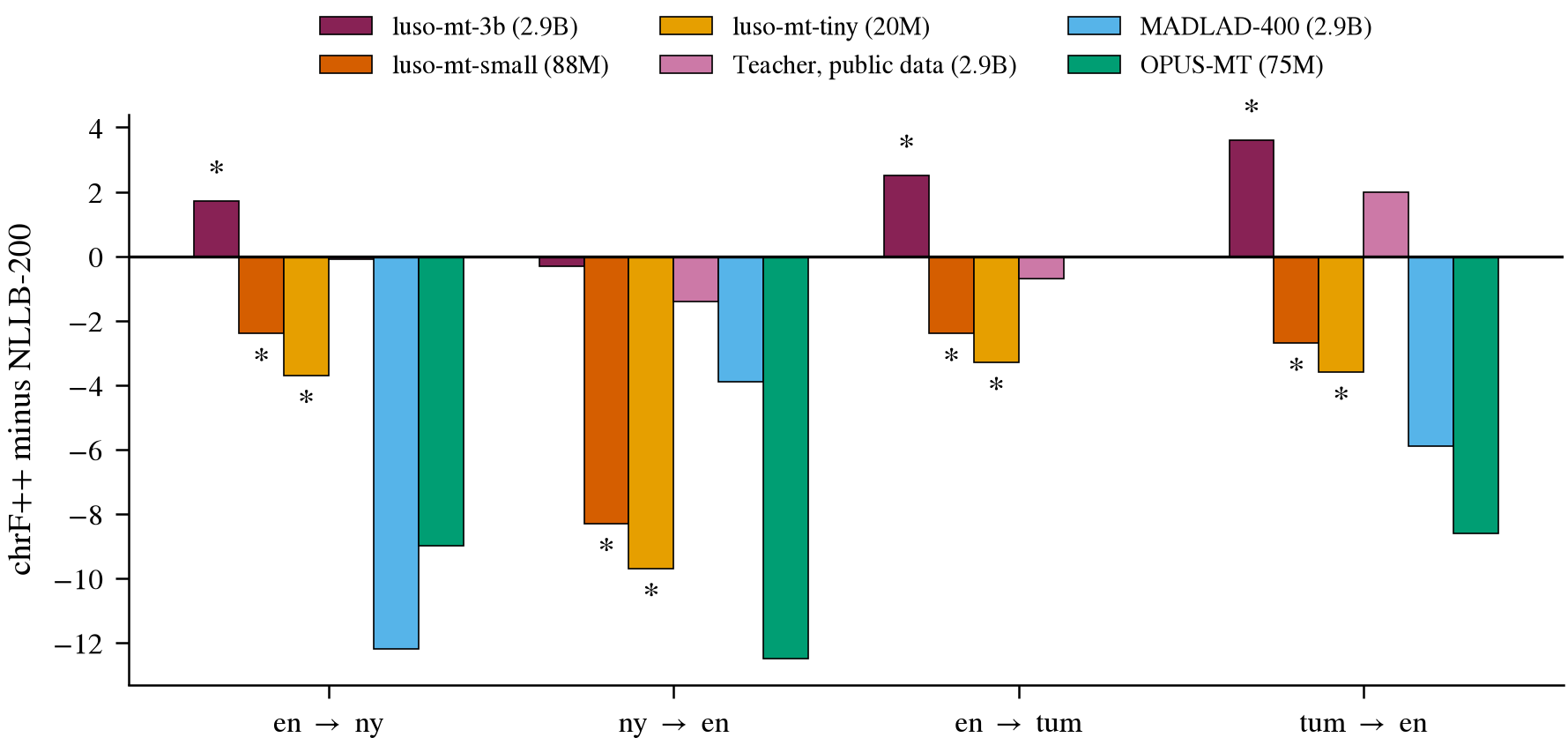
luso-mt-small is significantly better than OPUS-MT in the three directions both support (+6.6 en→ny, +4.2 ny→en, +5.9 tum→en), and the two students are the only compact models in the comparison that translate into Tumbuka. luso-mt-tiny, with 4.4 times fewer parameters, is 0.9–1.4 chrF++ behind luso-mt-small. NLLB-200, seven times larger than luso-mt-small, leads it by 2.4 chrF++ into Chichewa and into Tumbuka, 2.7 out of Tumbuka and 8.3 out of Chichewa. luso-mt-small reaches 86–96% of its teacher's chrF++ and luso-mt-tiny 84–93%.
5.2 Teacher and luso-mt-3b
One epoch of fine-tuning raised MADLAD-400 from 37.8 to 49.9 chrF++ into Chichewa, from 51.3 to 53.8 out of Chichewa and from 26.8 to 34.7 out of Tumbuka; the new <2tum> tag reached 37.5 into Tumbuka. Continuing on the full corpus (luso-mt-3b) improved every direction by a further 1.1–3.2 points (p = 0.001). luso-mt-3b has higher chrF++ than NLLB-200 distilled 600M into Chichewa (+1.7, p = 0.002), into Tumbuka (+2.5) and out of Tumbuka (+3.6, both p = 0.001); out of Chichewa it is 0.3 lower (p = 0.19). Its BLEU into Tumbuka is lower than NLLB-200's (12.6 against 13.0), and it is almost five times larger.
5.3 Distillation, training exposure and student size
On the seed-13 runs, adding the teacher's translations raises test chrF++ in every direction, by 2.9–4.3 for luso-mt-tiny and 3.5–5.1 for luso-mt-small (p = 0.001 in each direction). Because the distilled runs also see twice as many rows per epoch under a higher epoch limit, this comparison confounds the teacher's translations with training exposure. The seed and control runs separate the two.
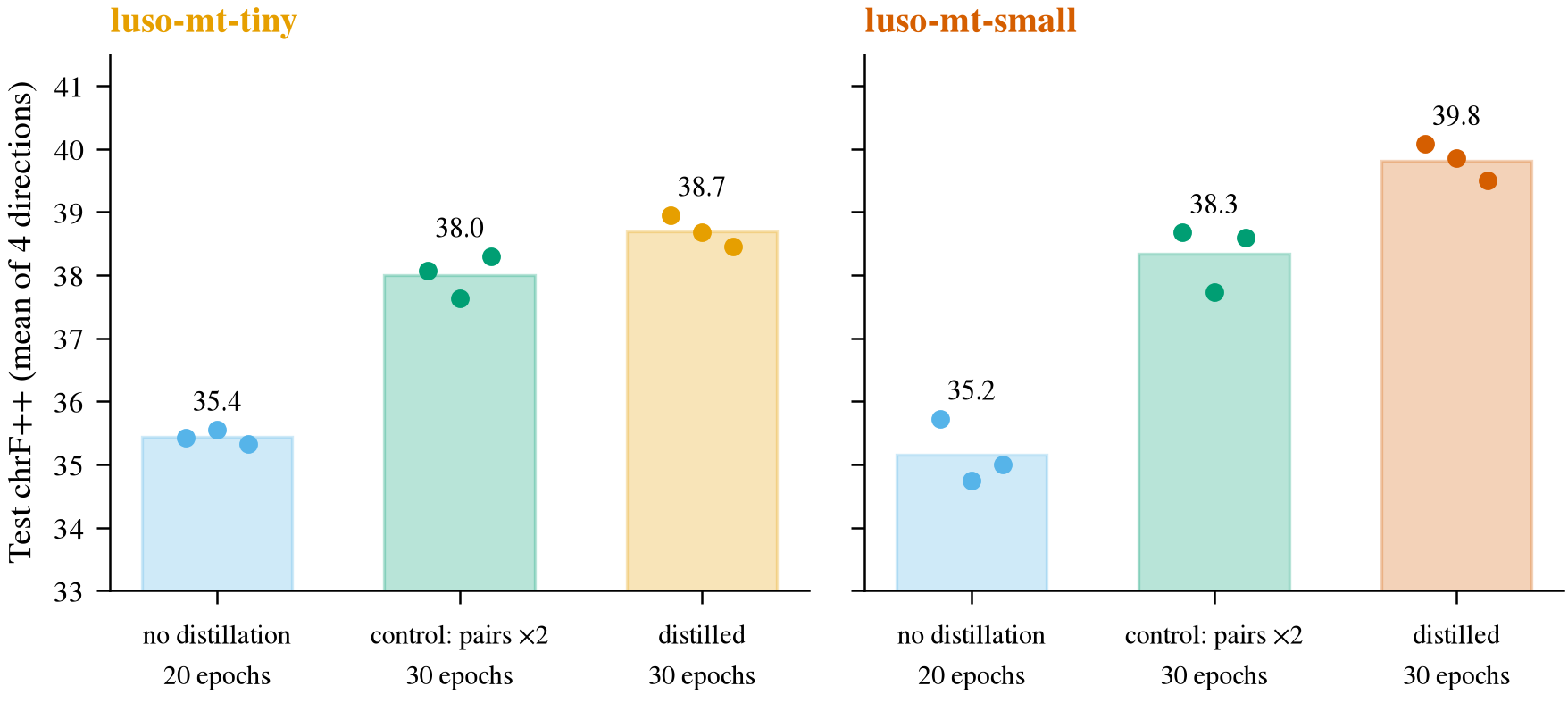
| Change (mean chrF++, 95% CI over seeds) | luso-mt-tiny | luso-mt-small |
|---|---|---|
| Teacher's translations (distilled − control) | +0.7 [0.0, +1.4] | +1.5 [+0.4, +2.6] |
| Training exposure (control − 20-epoch baseline) | +2.6 [+1.8, +3.3] | +3.2 [+2.0, +4.3] |
| Total (distilled − 20-epoch baseline) | +3.3 [+2.7, +3.8] | +4.7 [+3.6, +5.7] |
| Student size (luso-mt-small − luso-mt-tiny) | ||
| no distillation, 20 epochs | −0.3 [−1.5, +0.9] | |
| control, 30 epochs | +0.3 [−0.7, +1.4] | |
| distilled, 30 epochs | +1.1 [+0.5, +1.7] |
Exposure accounts for most of the gain. Averaged over directions and seeds, distillation raises chrF++ by 3.3 (luso-mt-tiny) and 4.7 (luso-mt-small) over the 20-epoch baseline. The control recovers 2.6 and 3.2 of these points (79% and 68%), leaving 0.7 and 1.5 attributable to the teacher's translations. For luso-mt-small the remainder is consistent: every distilled seed scores above every control seed in all four directions (p = 0.02). For luso-mt-tiny it is not significant (p = 0.053). Without distillation the two student sizes perform alike; with distillation luso-mt-small leads by 1.1.
What the control matches. The 20-epoch baselines reached their best development score at the last or second-to-last evaluation, so the epoch limit ended them while they were still improving. The controls and distilled runs were ended by early stopping, but at different points: the selected control checkpoints come from 40,000–86,000 optimiser steps and the distilled ones from 76,000–104,000. The control therefore matches the data seen per epoch and the training budget, not the number of updates. Whether the teacher's translations help by improving the targets or by allowing useful training to continue longer cannot be separated with this design.
Variation across seeds. Standard deviations across seeds are 0.1–0.9 chrF++ per direction. The released seed-13 students score 0.3 chrF++ above the means of their conditions, so their scores above are slightly favourable relative to a typical run.
A failed first run. The first students used subword sampling with alpha 0.1 over all segmentations, which cut words into near-character fragments; luso-mt-tiny produced fluent output unrelated to the source and stopped at epoch 10.3. The corrected runs changed several settings at once, so the failure is most plausibly explained by the segmentation, but the cause is not isolated.
5.4 Analysis
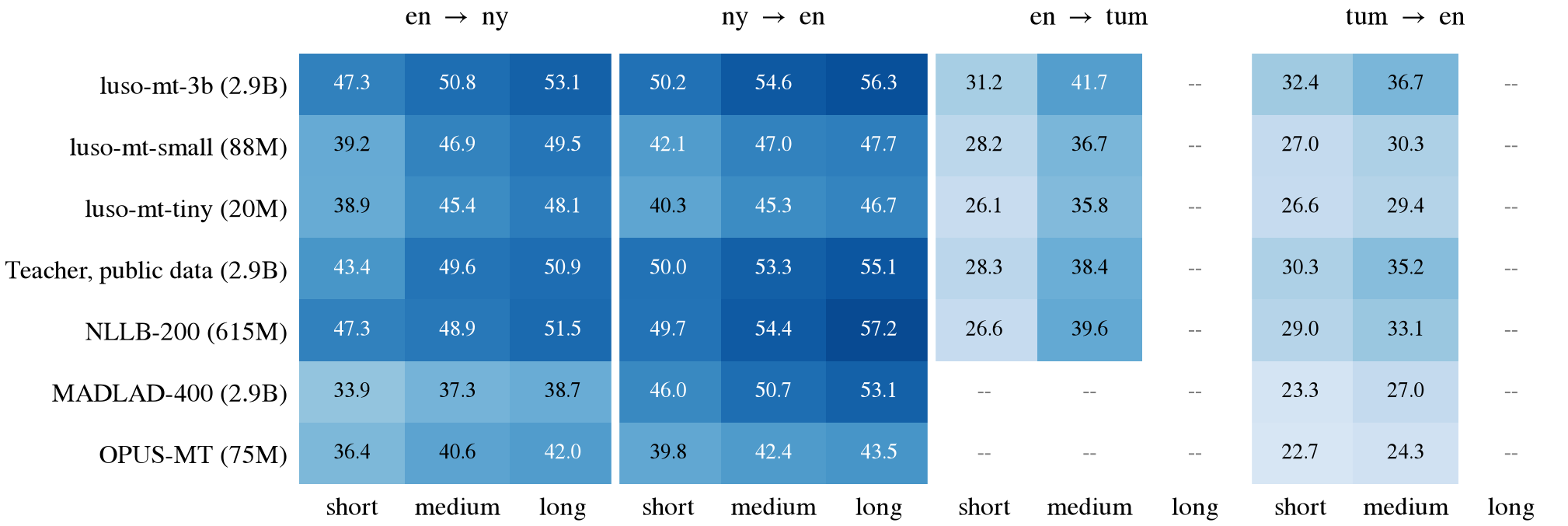
Sentence length. All systems score lower on short sentences. Into Chichewa, the gap between luso-mt-small and NLLB-200 shrinks from 8.1 points on short sentences to 2.0 on long ones; out of Chichewa it remains large at every length.
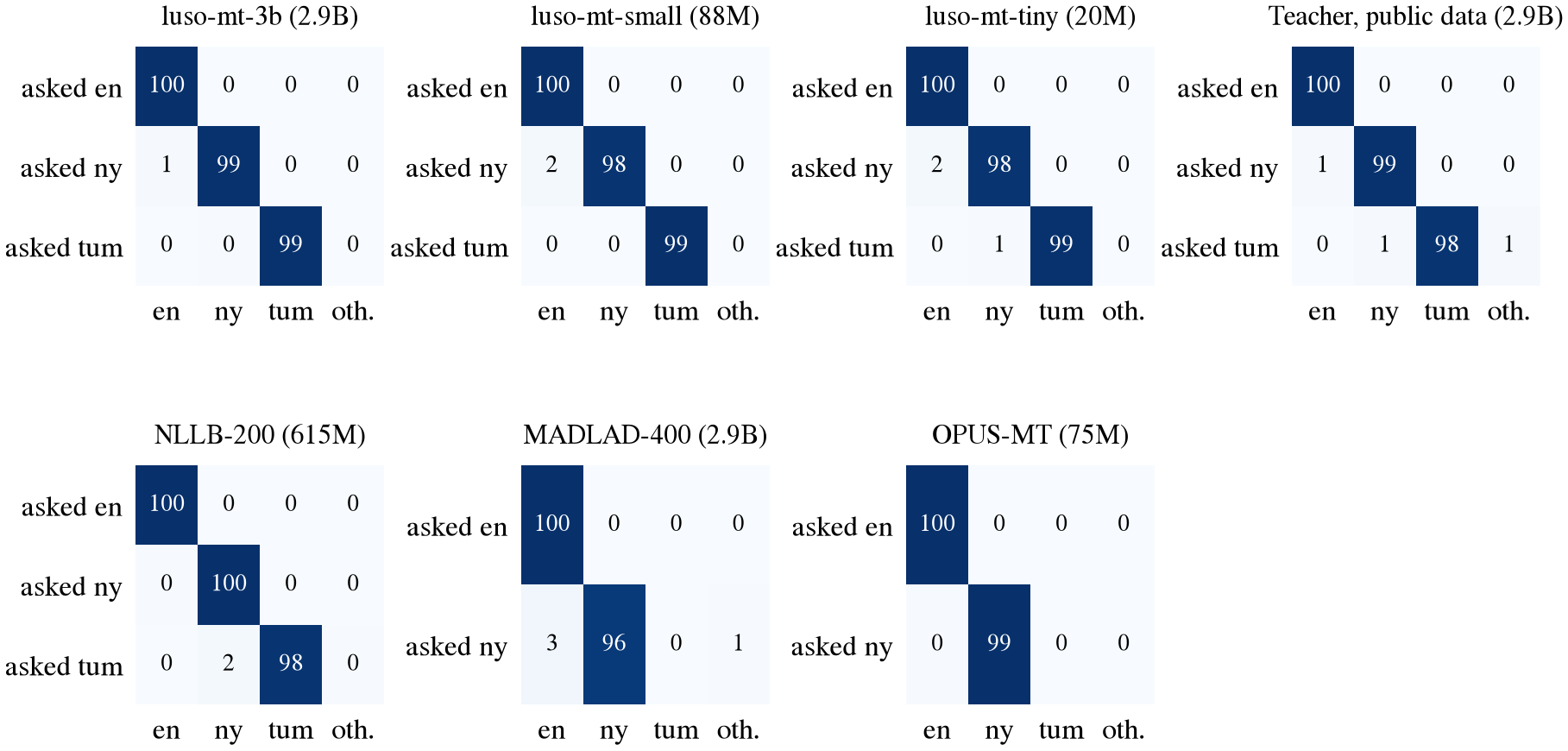
Language identity. All luso-mt models produce the requested language in 98–100% of outputs; asked for Tumbuka, luso-mt-small never answered in Chichewa and luso-mt-3b did so in 0.4% of cases, against 2% for NLLB-200. Producing the right language does not imply a correct translation.
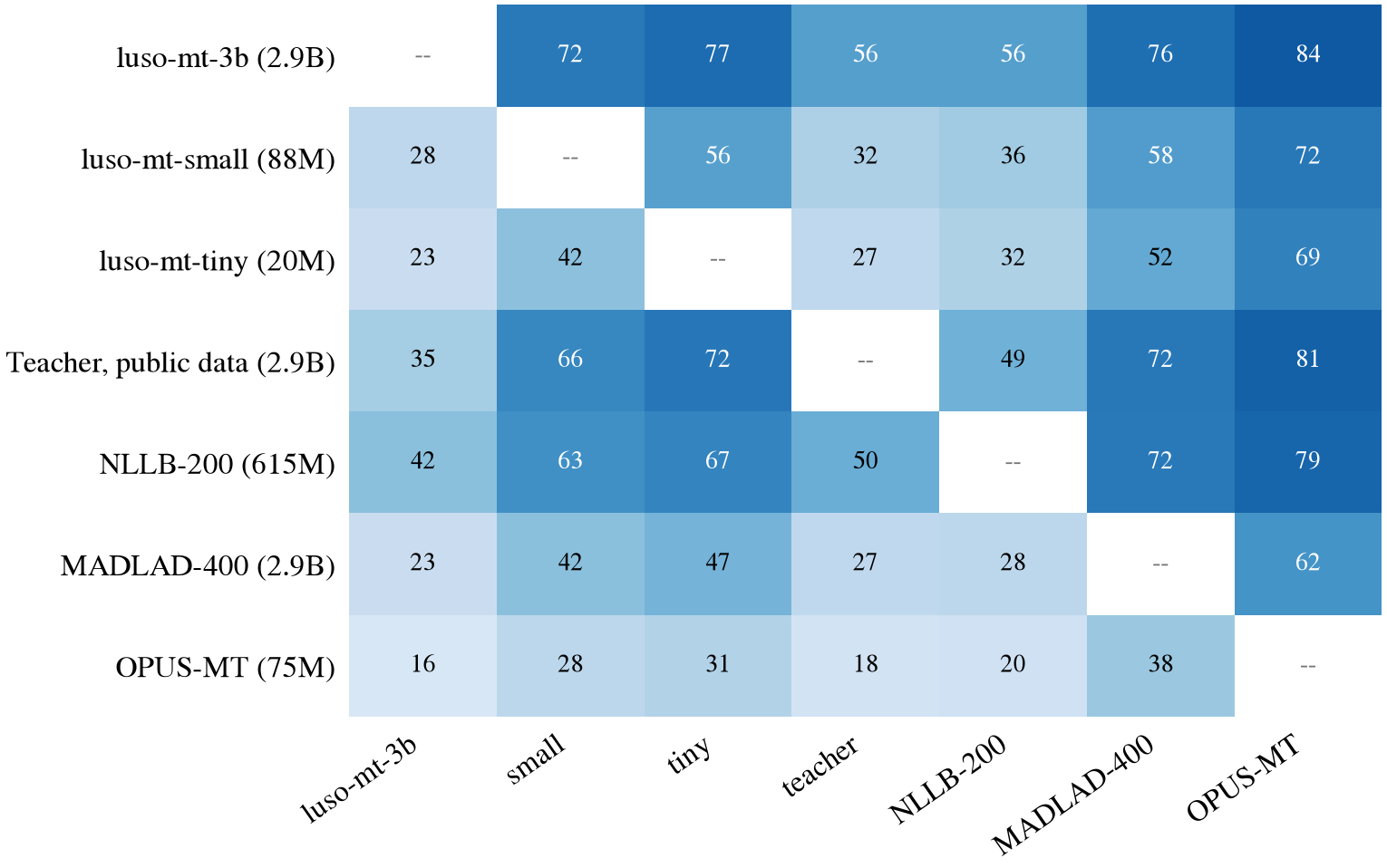
Sentence-level comparison. luso-mt-small scores higher than OPUS-MT on 72% of sentences and higher than NLLB-200 on 36%; luso-mt-3b scores higher than NLLB-200 on 56.5%. A higher sentence-level score is not the same as a better translation.
Training-to-development gap. On 500 human-translated training pairs per direction, luso-mt-small scores 6.4, 9.6, 14.8 and 21.2 chrF++ above its development score (en→ny, ny→en, en→tum, tum→en); luso-mt-tiny 4.1, 4.1, 11.4 and 12.7. The gap is larger for Tumbuka, whose pairs are repeated in training. Such gaps can reflect overfitting but also differences between training and development distributions.
Errors. Its errors are lexical and semantic, and some are serious: a unit changed from inches to millimetres without changing the number, and the colloquial word for diabetes rendered as music. Such errors produce fluent output in the right language and are only partly visible in automatic metrics.
6. On-device evaluation
| Model | Parameters | fp32 file | int8 file | fp32, greedy | fp32, beam 4 | int8, greedy |
|---|---|---|---|---|---|---|
| luso-mt-tiny | 19.9M | 79.5 MB | 40.5 MB | 8.32/s | 8.21/s | 11.96/s |
| luso-mt-small | 87.7M | 350.9 MB | 153.5 MB | 2.96/s | 3.11/s | 7.28/s |
Sentences per second on an 8-vCPU server, batch size 1, 40 news sentences into Chichewa in a single run; int8 is PyTorch dynamic quantisation of the linear layers. Both students meet their storage budgets. Int8 quantisation changes chrF++ by at most 0.3 points in any direction for either student.
Export for Android. Both students were exported to ONNX for the luso8 Android application. The fp32 ONNX models reproduce the PyTorch outputs exactly on 200 test sentences per model, and int8 ONNX quantisation changes chrF++ by −0.1 to +0.2 relative to the fp32 ONNX models. In an initial manual test the int8 luso-mt-tiny translated offline inside the application; no latency, memory or battery measurements on phones have been made yet.
7. Discussion
Compression. Most of the teacher's automatic score survives a reduction to 1/148 of its parameters, and a four-fold larger student adds only about one chrF++ point. Under the size budgets of this work luso-mt-tiny is the more efficient model.
Translation into English. The students lose most relative to their teacher when translating into English: luso-mt-small is 6.9 chrF++ below the teacher out of Chichewa and 4.7 out of Tumbuka, against 2.3 into Chichewa and 1.7 into Tumbuka. In the public-source partition 95% of the English targets are Gemini translations, whereas the Chichewa and Tumbuka targets are natural text. A plausible explanation is that a small student trained from scratch fits synthetic English less well than a teacher pretrained on large amounts of English; this has not been tested.
Distillation and exposure. The single-seed ablation suggested gains of up to 5.1 chrF++ from distillation; the control attributes most of this to longer training on more rows. The remainder is consistent with Kim and Rush (2016), and its being larger for the larger student suggests that luso-mt-small can exploit the teacher's outputs where luso-mt-tiny is closer to its capacity. Distillation gains reported without an exposure control can overstate the contribution of the teacher.
Cost. The training experiments used 70.6 GPU-hours, about US$351 at list price, of which the seed and control runs account for 39.7 hours. This excludes synthetic data generation, data collection, storage and human evaluation.
8. Conclusion and future work
RQ1. On the selected test sets, luso-mt-small is significantly better than the per-pair OPUS-MT models, the evaluated models closest in size, in every direction both support, and the two students are the only compact models evaluated that translate into Tumbuka. RQ2. luso-mt-tiny keeps 84–93% of the teacher's chrF++ at 1/148 of its size and 40.5 MB in int8, and int8 quantisation costs at most 0.3 chrF++. The gap to large models is largest from Chichewa into English. Inference speed has been measured on a server CPU only. RQ3. Over three seeds, most of the gain from adding teacher translations comes from additional training exposure; at matched rows per epoch the teacher's translations add 1.5 chrF++ to luso-mt-small and 0.7 to luso-mt-tiny, which is not significant.
Future work. These conclusions rest on automatic metrics and server measurements. Work under way will test and extend them:
- Human evaluation. A blind evaluation by bilingual evaluators, collected through a Model Lab in Corpus Studio and the luso8 Android application.
- Benchmarks on phones. Loading time, memory, latency, on-device quality and battery use on a low-end and a mid-range Android device.
- More data. Human Chichewa and Tumbuka translations from Corpus Studio, extending both the training data and the test sets.
- Model improvements. Longer training budgets and students distilled from luso-mt-3b, which would test whether teacher quality bounds student quality.
9. Limitations
- Automatic metrics only. chrF++ and BLEU differences are not human quality judgements; human evaluation is under way.
- Small, single-reference test sets of 500 sentences per direction, from different domains for the two languages.
- Seeds. Student conditions use three seeds, which estimate run-to-run variation only roughly; the teacher and luso-mt-3b were trained once.
- Exposure matched per epoch, not per update. Early stopping ended control and distilled runs after different numbers of optimiser steps, and each run trains its own vocabulary.
- Synthetic English. Most English training text was produced by Gemini and Gemma; it may carry the style of those systems, and quality into English remains the weakest.
- Architecture not ablated. The design choices follow prior work.
- No systematic phone measurements.
10. Responsible use and release
The models are intended for general translation, assistive reading and writing, and as components of local applications. They are not suited to unreviewed medical, legal or safety-critical translation; names, numbers, units and specialised terms should be checked. Releasing a model under Apache-2.0 does not by itself establish that every training source and synthetic output is cleared for every commercial use; the full report lists the terms of each source. All three models are released under Apache-2.0 as weights only; the training corpus, including the restricted partition used for luso-mt-3b, is not released.
Acknowledgements
We thank the contributors who record and annotate Chichewa and Tumbuka with us in Corpus Studio, and the authors of the datasets, models and tools this work builds on, in particular SMOL, NTREX-128, FineWeb-2, HPLT, MADLAD-400, GlotLID, MillID, SentencePiece and sacreBLEU.
References
- Bogoychev, N. et al. (2020). Edinburgh's Submissions to the 2020 Machine Translation Efficiency Task. WNGT.
- Caswell, I., Chelba, C. and Grangier, D. (2019). Tagged Back-Translation. WMT.
- Caswell, I. et al. (2025). SMOL: Professionally Translated Parallel Data for 115 Under-represented Languages. WMT.
- Johnson, M. et al. (2017). Google's Multilingual Neural Machine Translation System: Enabling Zero-Shot Translation. TACL.
- Kargaran, A. H. et al. (2023). GlotLID: Language Identification for Low-Resource Languages. Findings of EMNLP.
- Kasai, J. et al. (2021). Deep Encoder, Shallow Decoder: Reevaluating Non-autoregressive Machine Translation. ICLR.
- Kim, Y. and Rush, A. M. (2016). Sequence-Level Knowledge Distillation. EMNLP.
- Kocmi, T. et al. (2021). To Ship or Not to Ship: An Extensive Evaluation of Automatic Metrics for Machine Translation. WMT.
- Koehn, P. (2004). Statistical Significance Tests for Machine Translation Evaluation. EMNLP.
- Kudugunta, S. et al. (2023). MADLAD-400: A Multilingual and Document-Level Large Audited Dataset. NeurIPS Datasets and Benchmarks.
- NLLB Team (2022). No Language Left Behind: Scaling Human-Centered Machine Translation.
- Papineni, K. et al. (2002). BLEU: a Method for Automatic Evaluation of Machine Translation. ACL.
- Popović, M. (2017). chrF++: words helping character n-grams. WMT.
- Sennrich, R., Haddow, B. and Birch, A. (2016). Improving Neural Machine Translation Models with Monolingual Data. ACL.
- Tiedemann, J. and Thottingal, S. (2020). OPUS-MT: Building Open Translation Services for the World. EAMT.